A-Yokai-A-Day: Momonjii

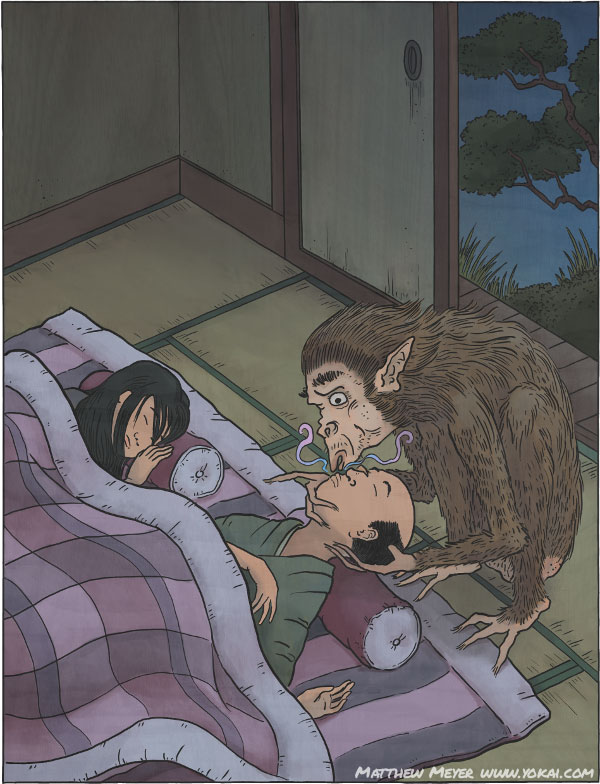
Today’s yokai is the third and final “evolution” of the adorable nobusuma which we looked at earlier, and it is no longer cute at all.

This was the first of the really difficult entries to do for The Hour of Meeting Evil Spirits. Most yokai that I translate are pretty straightforward—they really only exist as a couple of sentences in old storybooks, and they are pretty simple and easy to understand. And then there are others that include really subtle jokes or references that require a really in-depth knowledge of the pop culture of the time these creatures were in vogue. This is one of those strangely detailed ones that is hard to understand if you only look at it in today’s light.

A number of yokai master Toriyama Sekien’s creations included references to hanafuda, a card game that was extremely popular in the Edo period. (It’s still somewhat popular today, and a pretty fun game!) I won’t go so much into the details here because I do so on the yokai.com page, but let me just say it was not obvious at first sight! It took a lot of translating, researching, and helpful explanations by my wife to figure out all of the weird cultural connections associated with this yokai. While now I can look at it and say, “Ooooooh, that makes perfect sense,” before it all would just gone over my head.

When I read about these yokai, I wonder how obvious certain things like that would have been to contemporary residents of Edo, and the purchaser of Sekien’s books… Would common folks have immediately gotten the jokes, or would they have to be aristocrats or literati in order to fully appreciate the amazing subtle touches that he put in his yokai encyclopedias? Even when he only writes one or two sentences about a yokai, the name and the illustration alone can say so much more. Toriyama Sekien truly was a great artist!

百々爺 / ももんじい / Momonjii

百々爺 / ももんじい / Momonjii

Head of over to yokai.com to read the whole story about this creepy old man yokai who evolves from a humble bat, and to learn about the crazy cultural references that Toriyama Sekien managed to squeeze into his description!

A-Yokai-A-Day: Yamachichi

Welcome back for day 3 of A-Yokai-A-Day 2014 edition!

Today’s yokai is quite funny, though you wouldn’t think so if you were on the receiving end of its attack I suppose…

I say it’s funny because of mostly how it looks, but also because the idea is just so bizarre! A soul-sucking vampiric monkey which is actually a transformed bat who kisses people in the night to steal their life force… while I can’t say it doesn’t get any weirder than that (these are yokai we are talking about, after all) this does rank pretty high on the strangeness scale.

Researching animal yokai is always quite fun. Many animals in Japanese folklore will actually evolve into other animals as they age, and eventually into yokai, but it is rare that one yokai evolves into another. It shows that in old Japan there really was not much of a difference between what constitutes a yokai and an animal—these were all believed to be living things inhabiting the same world as people. Some of what we see today as the “magic powers” that some of these yokai had were not really considered magical at all. In many cases, they were considered completely natural phenomena.

What makes this animal/yokai so particularly interesting is that, while transforming from one creature into another is not uncommon, transforming multiple times into such different monsters is fairly rare among yokai. That is why I say that this is truly one of the most “Pokemon-like” yokai out there.

Anyway, here is the painting. Click for the full description on yokai.com!

Yamachichi / 山地乳 / やまちち

Yamachichi / 山地乳 / やまちち

A-Yokai-A-Day: Nobusuma

Today we continue A-Yokai-A-Day with another cute-yet-creepy yokai. Though similar-looking to yesterday’s nodeppou, today’s nobusuma has very different origins and slightly different behavior.

The most fascinating thing about today’s yokai is that not only does it evolve from a regular animal into a yokai, it evolves again and again into more powerful yokai forms! Does that sound familiar? If you are at all interested in Japanese pop culture, it should!

Though not a direct ancestor of Pokemon, there is no doubt that Pokemon were deeply influenced by the yokai tradition. In fact, some Pokemon are direct copies of certain yokai, though with newer-sounding names tacked on. The nobusuma, being one of the most dynamically changing yokai over its lifespan, really evokes the feeling of Pokemon or other video game characters morphing into a new form when they reach a certain power level. Today you get to see its first yokai form (evolved from a wild bat), and later this week we will look at some of its more advanced yokai forms!

Nobusuma / 野衾 / のぶすま

Nobusuma / 野衾 / のぶすま

To learn more about nobusuma and other awesome yokai, visit yokai.com/nobusuma. And if you haven’t yet, don’t forget to check out my book on Amazon.com, in paperback and Kindle formats!

A-Yokai-A-Day: Nodeppou

Greetings readers! Long time no blog! I have been busy painting yokai for my upcoming book, The Hour of Meeting Evil Spirits, and I haven’t spent much time posting because of that. If you’ve been following me on Facebook, you’ve probably seen a few previews of the illustrations for the book. No doubt you have been wondering what some of the yokai are and wanting to learn more about them! Well never fear, because A-Yokai-A-Day is here back!

As in past years, I will be revealing a new yokai each day of this month. As I am hard at work on the new book, this year each yokai will be an entry from the book in progress. This means that those of you who are Kickstarter backers may already have seen some of these yokai, but I only have so many hours in a day to paint, so that’s the best I can do. I hope you enjoy them all the same! For those of you who missed the Kickstarter, these will be new yokai for you, so I know you will enjoy them!

I will be posting the yokai entries on yokai.com, while here on MatthewMeyer.net I’ll be talking about the yokai and the process of making them in a more casual manner. Sort of a behind-the-scenes of the making of the book and of the entries on yokai.com. I will be posting the illustrations on both sites.

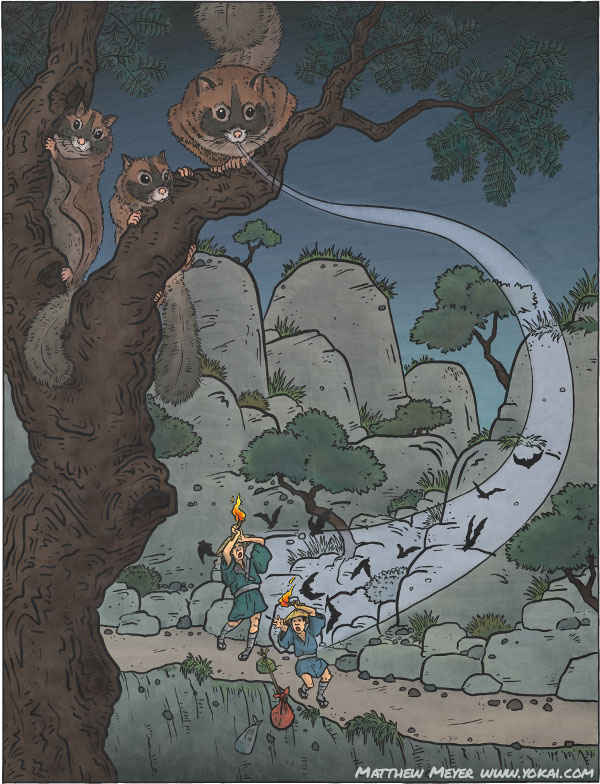
As usual, I will be starting off with some softer, tamer yokai and moving towards the more grotesque and scary ones as we get closer to Halloween. Today’s yokai is pretty darn cute, but you wouldn’t want to cuddle this vampiric flying squirrel!

Nodeppou / 野鉄砲 / のでっぽう

Nodeppou / 野鉄砲 / のでっぽう

To learn more about nodeppou and other awesome yokai, visit yokai.com/nodeppou. And if you haven’t yet, don’t forget to check out my book on Amazon.com, in paperback and Kindle formats!

A-Yokai-A-Day 2013 Line-Up

A-Yokai-A-Day is over, and sadly you will have to wait 11 more months until fresh new yokai illustrations appear on this blog again. In the meantime, though, you can enjoy the A-Yokai-A-Day archives from past years (2012, 2011, 2010, 2009) as well as this year’s selection of yokai. Here is the grand list of all of the yokai posts from this year’s edition of A-Yokai-A-Day: Continue reading →

A-Yokai-A-Day: Shiryō

Happy Halloween!

Today marks the final day in this year’s A-Yokai-A-Day, as well as the final day in The Hour of Meeting Evil Spirits Kickstarter project. Starting tomorrow all of the Kickstarter updates will be private to backers only, so now is your last chance to get in, even at the $1 level! Just over an hour left to join! Don’t miss out!

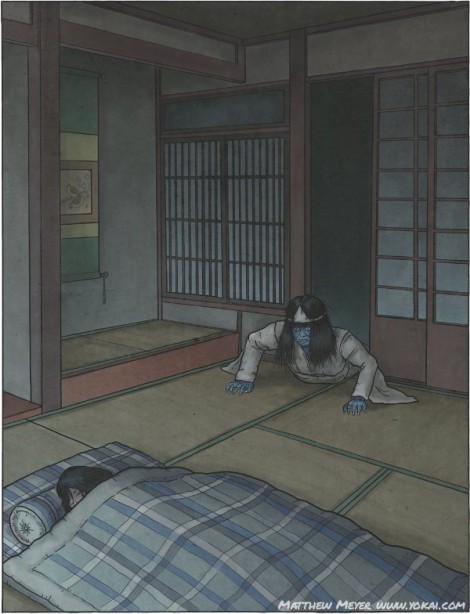
Shiryō (死霊, しりょう)

Shiryō means “dead ghost” and stands in contrast to the ikiryō, or living ghost.

Shiryō can be considered synonymous with yūrei (“faint spirit”), as they are both words for the classic Japanese ghost. However while yūrei can be creepy some times and beautifully mysterious at other times, shiryō is only used to refer to scary, nasty ghosts. The inclusion of the kanji for “death” in the name is the clue that this ghost is not to be romanticised.

Shiryō can act in similar ways as ikiryō, appearing to relatives or close friends of the deceased. While ikiryō usually appear in the moments just before death, a shiryō appears in the moments just after death. When they appear, it is most often to give one last goodbye to their loved ones before departing… however, when a shiryō appears it is not always to say goodbye, but instead to take their loved ones with them into the world beyond…

Shiryō belief goes back into the mists of unrecorded history in Japanese folklore, and has long been a staple of folk superstition. One famous account is recorded in the Tōno Monogatari, a 1910 collection of folk beliefs which gave birth to the field of academic folklore research in Japan. In this story, there was a young girl who lived together with her father. After her father died, his shiryō appeared before the young girl and tried to take her with him into the world of the dead. The girl narrowly escaped and fled from the house to ask for help. Every night, various friends and distant family members agreed to stay overnight in the house with her and watch over her, and every night without fail, her father’s shiryō came looking for her, to try to take her away. Finally, after a month of sleepless, terrifying nights, the ghost stopped appearing, and the girl was left in peace.

Shiryou

A-Yokai-A-Day: Ikiryō

Wow, the end of the month really just snuck up on me. I can’t believe it is October 30th today and I just have these last two yokai to do until A-Yokai-A-Day ends! Remember: tomorrow will be the last A-Yokai-A-Day of 2013, and also your last chance to join in the awesomest Kickstarter ever! Don’t miss out!

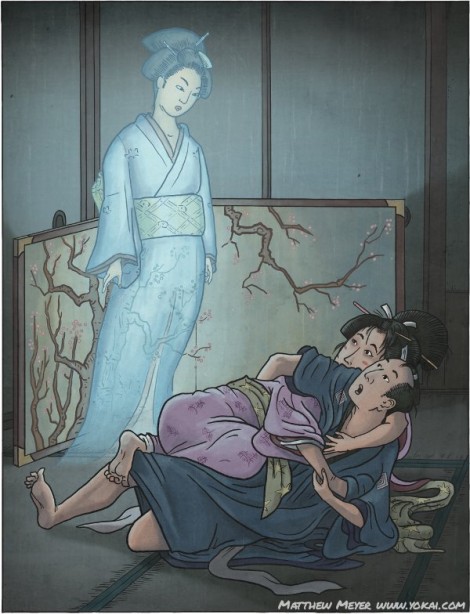
Ikiryō (生霊, いきりょう)

While there are many types of ghosts in Japanese folklore and urban legend, (not to mention demon ghosts and yokai ghosts and all of the yokai that are born from dead people) one that we have not yet looked at on this blog is the living ghost, or ikiryō (or ikiryou).

The ikiryō is pretty straightforward — it is an apparition of a currently living person which appears to someone. Essentially, the soul leaves the body to go and do something else. There are a number of ways ikiryō can appear out of the body: during a near-death-experience, fainting, intense passion or need to see someone, intense hatred, or even to deliver the same sort of grudge-curse that onryō deliver. That’s right, you don’t even have to be dead to become a Japanese ghost!

Ikiryō are a very ancient belief, and go back to some of the oldest superstitions found in Japan. They also make numerous appearances in literature through Japanese history. One very famous example comes from The Tale of Genji: Lady Rokujo’s living ghost haunts and curses a young woman named Aoi no Ue, who is pregnant with Genji’s child. (Part of that story will actually be told in The Hour of Meeting Evil Spirits, so I won’t go into too much detail here.)

While the scary, nasty ikiryō born out of hatred or a desire to kill someone are the most common kind of ikiryō, there are also a number of stories about ikiryō which form out of burning love and desire for someone. If a person’s love is strong enough, her spirit (it is usually a woman…) can depart her body, even without her knowing it, and visit her lover. Such a thing happened to a young man from Kyoto in the 1700’s. A girl from his neighborhood fell in love with him, and her love was so strong that it formed an ikiryō. Her spirit haunted him so aggressively, whispering her love in his ear, and violent grabbing him and moving him around that he ended up falling ill and became bedridden with sickness.

Ikiryō can also leave from the body during sleep for no apparent reason. A story from the 1600’s tells about a young women whose spirit left her body every night while she slept, without her knowledge. It would roam the streets and scare young men, who thought it was a monster and attacked it. Every morning the woman woke up terrified, having dreamed of being chased by men all night long.

Another very common type of ikiryō is one that appears at the moment just before dying. According to old folk beliefs, just before death, the soul leaves the body and walks around, making noises and doing things outside of the body. This is especially common during wartime, and often the ikiryō of soldiers even in far off lands are said to appear to their friends and loved ones moments before or after their death, in their war uniforms, to give one last goodbye. In olden times, it was said that the souls of the soon-to-die and recently-deceased could be seen visiting nearby temples and praying for the few days surrounding their deaths.

During the Edo period, ikiryō were considered a symptom of certain illnesses, such as the aptly-named rikonbyō, or “detached soul syndrome,” and kage no yamai, or “shadow illness.” These horrifyingly-named diseases were Edo period names for sleepwalking and out-of-body experiences. When the ikiryō left the body, it could sometimes take the person’s consciousness along with it, causing them to experience life from the ikiryō as if they were actually doing it, including meeting their own self (sort of like a Japanese doppelganger).

Finally, one could even purposefully summon his or her own ikiryō by performing a curse-ritual. One is known as ushi no koku mairi. I mentioned this curse briefly in the Hashihime entry, and it will also get its own entry in the book, but the basic idea is that by performing this ritual, you could transform yourself into an oni and send your soul off to do some evil — usually kill someone. Another curse, called ichijama, is from Okinawa, and follows roughly the same idea. What makes these ikiryō interesting is that while most ikiryō are spirits that wander about and do things while their owners are unconscious and unaware of what they are doing, these spirits are fully conscious, intentional uses of an ikiryō, making them more than just a little terrifying…
Ikiryou