Hishaku & Hinoshu

Greetings yokai fans!

I hope you are all having a good holiday. New Years is just around the corner and I am preparing to head back to Japan to continue working on yokai!

Today I am posting the next set of microbial yokai. This posting covers two main types of these yokai, shu and shaku. We saw a kan no mushi last time and I talked a bit about that… Shu and shaku are hard to translate, so I ended up leaving their names as shu and shaku. The reason is because these are different types of bugs, and they are so tied in with Chinese magic that is becomes very hard to accurately translate them. I’ll try to do a bit of explanation here, before the posts.

Shaku have defined shapes and forms. They infect specific parts of the body each time, and are pin-pointable. Their illnesses are usually illness “of the blood” (a vague term in Chinese medicine, which I’m not advocating here, but just describing as the yokai are described in Edo-period textbooks!). The main idea behind this “theory” is that blood can become too hot or cold, or too slow, or too thin, and it causes various ailments. Shaku cause pain deep within the body. Shaku are tied to “in” (i.e. yin), the cosmic force of negativity and shadow.

Shu, on the other hand, do not have definite forms. They collect and dissipate, causing problems as they take various shapes. Shu cause pain on the surface of the body usually. Their ailments are not of the blood, but of the “ki” (another vague concept, called “chi” in Chinese, related to words like “reiki” — it basically means “energy”). Shu are related to “yo” (i.e. yang), the cosmic force of positivity and light.

If that’s a bit confusing, don’t worry, it is! If you read The Hour of Meeting Evil Spirits you’ll be a little familiar with in and yo and the cosmic forces, but that’s such a deep and confusing subject that it would take a whole other Patreon project to delve into its meanings. For our purpses, we just care about the yokai 😉 but it helps a bit to get a basic explanation of the energies we’re going to be talking about with these “disease yokai.”

Anyway, on to the yokai!

This post was made possible by the generous support from my Patreon backers. If you like yokai and want to learn more, please consider pledging $1 per month to support my work.

Become a Patron!

Haimushi, Hashaku, and Kiukan

Greetings yokai fans!

I hope the polar vortext is not making you too uncomfortable. It’s quite chilly here!

Of course in the cold weather, everyone seems to be catching colds, so it’s so appropriate that this month we’re looking at these “disease” yokai.

Our first three are ready. Hopefully you won’t catch one of them!

Haimushi http://yokai.com/haimushi/

Haishaku http://yokai.com/haishaku/

Kiukan http://yokai.com/gyuukan/

This post was made possible by the generous support from my Patreon backers. If you like yokai and want to learn more, please consider pledging $1 per month to support my work.

Become a Patron!

Jikininki

Greetings, yokai fans!

Tonight I bring you the jikininki. I included a creepy little tale that I really like! It’s based on Lafcadio Hearn’s story about the jikininki as well as an old story from Ugetsu Monogatari. It’s got just the right amount of creepiness to it. I think you’ll like it!

http://yokai.com/jikininki/

This post was made possible by the generous support from my Patreon backers. If you like yokai and want to learn more, please consider pledging $1 per month to support my work.

Become a Patron!

Kaichigo

Greetings yokai fans! And happy Thanksgiving!

On Thanksgiving my mother always pull old decorations out of the attic, such as a cornucopia, a teddy bear riding a sled, and some cute little sewn mice wearing pilgrim hats, among other things. These are Thanksgiving staples, and have been in my family since as long as I can remember; probably even before I was born. But every year it’s a welcoming sight to see the same old decorations layed out for Thanksgiving.

If this were old Japan, some of those things would probably become tsukumogami. I can imagine those little mice running around, stabbing at wooden turkeys and plastic fruits with their miniature forks and knives…

Today’s yokai sort of fits that theme, with a little bit of added mischief (“Hey! Who moved this piece?! I know it was one of you…”). It’s not Thanksgiving-related itself, of course, but it has that same quality. As a kid I always wanted to play with those objects, but since they were old I was told they weren’t toys for me to play with. Just like the kaichigo would be told about the precious shells he is playing with. I think the colors are quite Thanksgiving-y as well, so it’s a good post to share today.

You can read the post on yokai.com too: http://yokai.com/kaichigo/

This post was made possible by the generous support from my Patreon backers. If you like yokai and want to learn more, please consider pledging $1 per month to support my work.
Become a Patron!

Tennyo

Greetings yokai fans!

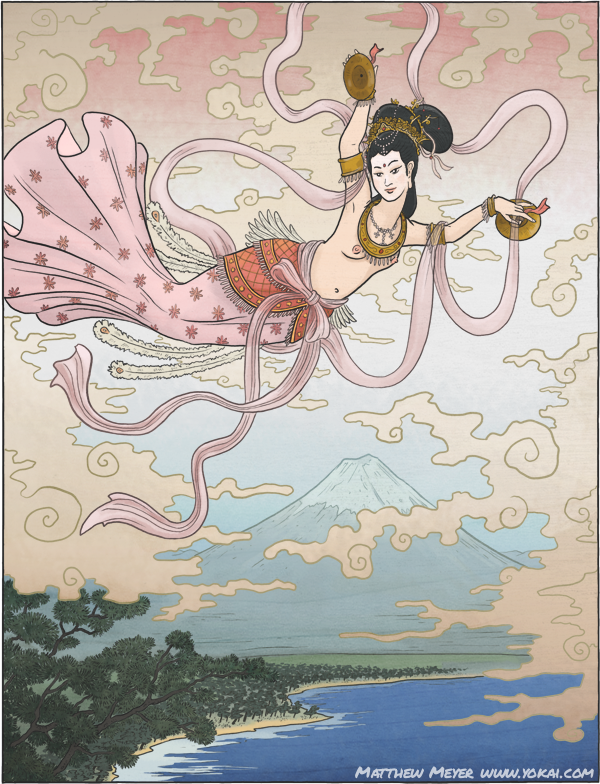
I’ve been so busy preparing for Comic Con in Baltimore this weekend that I wasn’t able to finish the writeup for August’s last yokai until today! So here it is, just half a day late. Tennyo, the celestial maiden:

This post was made possible by the generous support from my Patreon backers. If you like yokai and want to learn more, please consider pledging $1 per month to support my work.
Become a Patron!

Karura

Greetings, yokai fans!

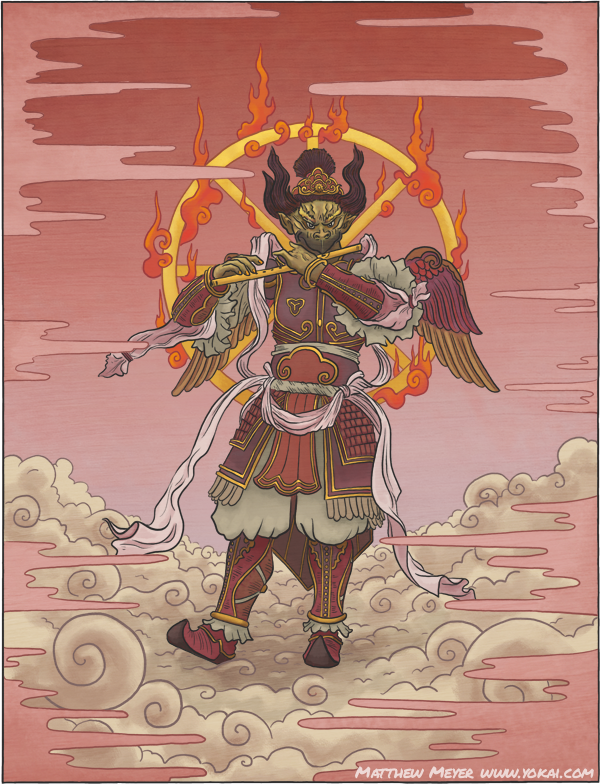
I’m back from Maine, and it was a great vacation (when I wasn’t getting eaten alive by biting flies that is!). I managed to do quite a bit of painting, and finished this one up over the week. I finished the writeup tonight, after getting home, and am ready to post it to share with all of you. If you remember the ashura entry from the Hour of Meeting Evil Spirits, or are interested in Japanese Buddhism, this should be even more interesting. I hope you enjoy it!

This post was made possible by the generous support from my Patreon backers. If you like yokai and want to learn more, please consider pledging $1 per month to support my work.

Become a Patron!