December-January Japan Trip

My wife’s brother happened to get married in December, which provided us the perfect excuse to go back to Japan for a short trip. With the Christmas and New Years holidays around the corner as well, it made sense to extend the vacation a bit and spend the whole month in Japan. This was awesome not only for the wedding, but because I got to spend my birthday, Christmas, and New Years (the absolute BEST Japanese holiday) in Japan, as well as having the chance to tour around and do some yokai research and collect visual reference for my next book. Continue reading

Yokai Museum

One of the reasons that I wrote The Night Parade of One Hundred Demons a few years ago is that there are so few books in English that deal with Japanese monsters, and of the ones that do exist there are so few that really give them the treatment that they deserve. Fortunately, yokai have been growing in popularity over the last couple of years, and finally some very interesting English-language books have begun to come out. Yokai Museum is one of these, having just been released in the US last month. I got my hands on a copy the other day, and I thought I would introduce it on my blog.

Yokai Museum

Yokai Museum is just what it sounds like: a museum of yokai-themed artwork spanning hundreds of years of history, condensed into book format. All of these works come from the vast collection of Yumoto Koichi — yokai researcher, professor, and former curatorial director of the Kawasaki City Museum. The Yumoto Koichi collection is the world’s largest collection of yokai-related art, and while Yokai Museum doesn’t come close to covering the 3,000 items in the Yumoto Koichi collection, it does cover an impressive selection of more than 161 pieces, detailed in high quality full color photos. The 288 page book is bilingual, featuring English translations side-by-side with the Japanese text, making it doubly useful as a language study tool for anyone looking to practice their Japanese (or English, for that matter). The descriptions are written with people who are not intimately familiar with yokai in mind, so they don’t require much foreknowledge to enjoy (and it is primarily a picture book, with only small written parts, like the tags you would see at a museum on the wall next to a piece).

Yokai Museum is divided into six chapters covering various formats of yokai art that appeared over time: picture scrolls, books, woodblock prints, games, everyday items, and religious items. Chapter 1: Picture Scrolls – A Cast of Colorful Yokai begins with the oldest known piece of true yokai art: the Hyakki Yagyō Emaki scroll attributed to Tosa Mitsunobu. It then shows a large number of other scrolls, including detailed close ups, and goes over the history and development of the styles used in these paintings. Chapter 2: The World of Yokai Books starts with Toriyama Sekien’s Gazu Hyakki Yagyō and moves on to the “yellow cover” books and other kusazoshi printed material from the Edo period. Chapter 3: Nishiki-e – A World of Gorgeous Color features the beautiful and colorful woodblock prints from the golden age of ukiyoe. Images by Hokusai, Yoshitoshi, and other masters are included alongside other less well-known pieces. Pictures of Edo period color newspapers, large format tryptichs, advertisements, and other old images are beautifully reproduced here. Chapter 4: Yokai Games is full of toys and games of all kinds from the Edo period up until the Showa period. There are illustrated board games, card games, fold-up paper models, kamishibai, and beautiful, strangely crafted mechanical wooden toys that would probably give any kid today nightmares! Chapter 5: Yokai Lurking in Everyday Life contains pictures of everyday items including kimono, obi, and other clothes, dishes, bottles, netsuke, even knife handles and sword guards. Chapter 6: Yokai and Prayer features a large number of votive cards that feature illustrations of various yokai on them. There are also works of art with religious significance which once belonged to various temples.

scrolls

prints

I was surprised at just how pervasive the yokai influence actually got to be. While I have long been a fan of the old prints and paintings from the Edo period, this was the first time I had ever seen yokai-themed kimonos, and that just blew me away! And while I had seen yokai paintings, prints, and netsuke, before, the votive cards and toys that were created over a hundred years ago (and look like they could have been made today) were amazing.

clothes

votive cards

My next book won’t be out until late next year, so if you are looking for some great yokai material to tide you over until then — particularly if you are interested in the artistic origins of yokai imagery — this is the book to get! Grab it on Amazon.com!

Yokai Museum is published by PIE International.

A-Yokai-A-Day 2013 Line-Up

A-Yokai-A-Day is over, and sadly you will have to wait 11 more months until fresh new yokai illustrations appear on this blog again. In the meantime, though, you can enjoy the A-Yokai-A-Day archives from past years (2012, 2011, 20102009) as well as this year’s selection of yokai. Here is the grand list of all of the yokai posts from this year’s edition of A-Yokai-A-Day: Continue reading

A-Yokai-A-Day: Shiryō

Happy Halloween!

Today marks the final day in this year’s A-Yokai-A-Day, as well as the final day in The Hour of Meeting Evil Spirits Kickstarter project. Starting tomorrow all of the Kickstarter updates will be private to backers only, so now is your last chance to get in, even at the $1 level! Just over an hour left to join! Don’t miss out!

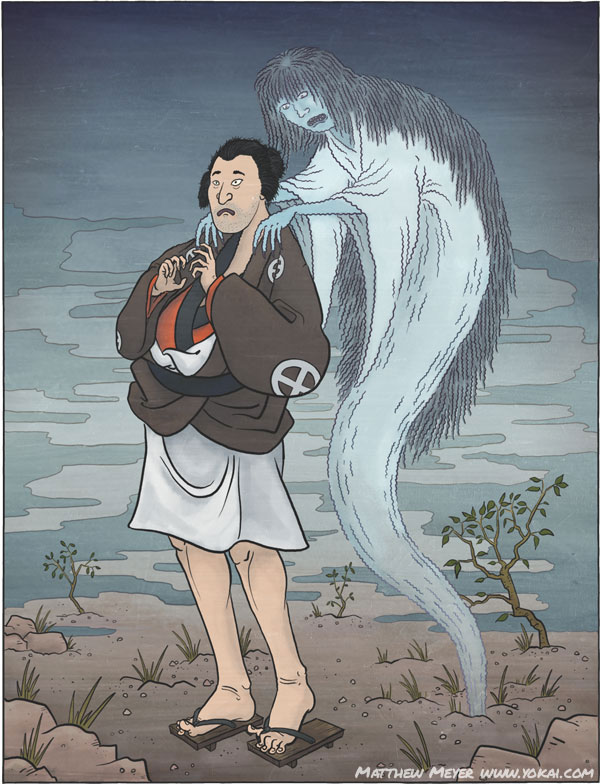
Shiryō (死霊, しりょう)

Shiryō means “dead ghost” and stands in contrast to the ikiryō, or living ghost.

Shiryō can be considered synonymous with yūrei (“faint spirit”), as they are both words for the classic Japanese ghost. However while yūrei can be creepy some times and beautifully mysterious at other times, shiryō is only used to refer to scary, nasty ghosts. The inclusion of the kanji for “death” in the name is the clue that this ghost is not to be romanticised.

Shiryō can act in similar ways as ikiryō, appearing to relatives or close friends of the deceased. While ikiryō usually appear in the moments just before death, a shiryō appears in the moments just after death. When they appear, it is most often to give one last goodbye to their loved ones before departing… however, when a shiryō appears it is not always to say goodbye, but instead to take their loved ones with them into the world beyond…

Shiryō belief goes back into the mists of unrecorded history in Japanese folklore, and has long been a staple of folk superstition. One famous account is recorded in the Tōno Monogatari, a 1910 collection of folk beliefs which gave birth to the field of academic folklore research in Japan. In this story, there was a young girl who lived together with her father. After her father died, his shiryō appeared before the young girl and tried to take her with him into the world of the dead. The girl narrowly escaped and fled from the house to ask for help. Every night, various friends and distant family members agreed to stay overnight in the house with her and watch over her, and every night without fail, her father’s shiryō came looking for her, to try to take her away. Finally, after a month of sleepless, terrifying nights, the ghost stopped appearing, and the girl was left in peace.

Shiryou

A-Yokai-A-Day: Ikiryō

Wow, the end of the month really just snuck up on me. I can’t believe it is October 30th today and I just have these last two yokai to do until A-Yokai-A-Day ends! Remember: tomorrow will be the last A-Yokai-A-Day of 2013, and also your last chance to join in the awesomest Kickstarter ever! Don’t miss out!

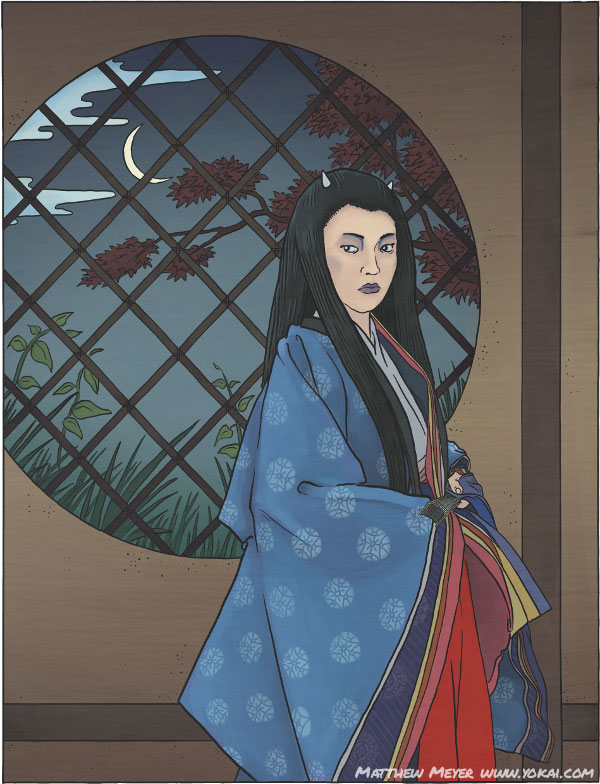
Ikiryō (生霊, いきりょう)

While there are many types of ghosts in Japanese folklore and urban legend, (not to mention demon ghosts and yokai ghosts and all of the yokai that are born from dead people) one that we have not yet looked at on this blog is the living ghost, or ikiryō (or ikiryou).

The ikiryō is pretty straightforward — it is an apparition of a currently living person which appears to someone. Essentially, the soul leaves the body to go and do something else. There are a number of ways ikiryō can appear out of the body: during a near-death-experience, fainting, intense passion or need to see someone, intense hatred, or even to deliver the same sort of grudge-curse that onryō deliver. That’s right, you don’t even have to be dead to become a Japanese ghost!

Ikiryō are a very ancient belief, and go back to some of the oldest superstitions found in Japan. They also make numerous appearances in literature through Japanese history. One very famous example comes from The Tale of Genji: Lady Rokujo’s living ghost haunts and curses a young woman named Aoi no Ue, who is pregnant with Genji’s child. (Part of that story will actually be told in The Hour of Meeting Evil Spirits, so I won’t go into too much detail here.)

While the scary, nasty ikiryō born out of hatred or a desire to kill someone are the most common kind of ikiryō, there are also a number of stories about ikiryō which form out of burning love and desire for someone. If a person’s love is strong enough, her spirit (it is usually a woman…) can depart her body, even without her knowing it, and visit her lover. Such a thing happened to a young man from Kyoto in the 1700’s. A girl from his neighborhood fell in love with him, and her love was so strong that it formed an ikiryō. Her spirit haunted him so aggressively, whispering her love in his ear, and violent grabbing him and moving him around that he ended up falling ill and became bedridden with sickness.

Ikiryō can also leave from the body during sleep for no apparent reason. A story from the 1600’s tells about a young women whose spirit left her body every night while she slept, without her knowledge. It would roam the streets and scare young men, who thought it was a monster and attacked it. Every morning the woman woke up terrified, having dreamed of being chased by men all night long.

Another very common type of ikiryō is one that appears at the moment just before dying. According to old folk beliefs, just before death, the soul leaves the body and walks around, making noises and doing things outside of the body. This is especially common during wartime, and often the ikiryō of soldiers even in far off lands are said to appear to their friends and loved ones moments before or after their death, in their war uniforms, to give one last goodbye. In olden times, it was said that the souls of the soon-to-die and recently-deceased could be seen visiting nearby temples and praying for the few days surrounding their deaths.

During the Edo period, ikiryō were considered a symptom of certain illnesses, such as the aptly-named rikonbyō, or “detached soul syndrome,” and kage no yamai, or “shadow illness.” These horrifyingly-named diseases were Edo period names for sleepwalking and out-of-body experiences. When the ikiryō left the body, it could sometimes take the person’s consciousness along with it, causing them to experience life from the ikiryō as if they were actually doing it, including meeting their own self (sort of like a Japanese doppelganger).

Finally, one could even purposefully summon his or her own ikiryō by performing a curse-ritual. One is known as ushi no koku mairi. I mentioned this curse briefly in the Hashihime entry, and it will also get its own entry in the book, but the basic idea is that by performing this ritual, you could transform yourself into an oni and send your soul off to do some evil — usually kill someone. Another curse, called ichijama, is from Okinawa, and follows roughly the same idea. What makes these ikiryō interesting is that while most ikiryō are spirits that wander about and do things while their owners are unconscious and unaware of what they are doing, these spirits are fully conscious, intentional uses of an ikiryō, making them more than just a little terrifying…

Ikiryou

A-Yokai-A-Day: Suiko

We are now counting down the hours instead of the days… just 48 hours left to become a backer of the best English-language yokai resource there is! Remember — even a $1 pledge gets you access to all of the updates and the making of the book. Once A-Yokai-A-Day ends, the Kickstarter backers will be the only ones getting the inside story on the rest of the yokai in this book!

Suiko (水虎, すいこ)

The suiko (“water tiger”) is found in both China and Japan, and is often confused with the kappa, another yokai which it closely resembles. However, the suiko is a different beast altogether and must not be confused with the kappa! Suiko are far more dangerous, violent, and hot-tempered than their meeker cousins.

Suiko are said to have the body of a small child, covered in extremely tough scales like a pangolin’s, and sharp hook-like protrusions on their kneecaps which resemble a tiger’s claws. They live near riverbanks and in large bodies of water. Like kappa, they enjoy using their superior strength to pull humans into water and drown them, although unlike kappa they have no concern for the shirikodama… (if you don’t know what the shirikodama is, you should read the kappa entry on yokai.com or this blog!). Instead, suiko drain their victims of blood, like vampires, and then eat their souls (reikon) and return the dead, drained body to the surface.

Suiko rank above kappa in the hierarchy of water goblins, and as such are sometimes placed in charge of them, acting like oyabun, or yakuza bosses, with one suiko placed in charge of 48 kappa. In turn, suiko report to the dragon king, who lives in a palace at the bottom of the sea and reigns over all sea creatures. It is said that the reason suiko kill humans is to increase their prestige and their standing with the dragon king. (Likewise it is said that when kappa attack humans, it is to make them look better and increase their standing with their boss suiko.)

Suiko who live in very large bodies of water like Lake Biwa and Chikugo River are said to sneak out of the water at night to play pranks, knocking on doors and running away, or possessing humans and making them do things.

To keep a suiko at bay, you can lean a sickle against the side of your house, and sprinkle flax seeds or black-eyed peas on the ground outside of your house. For some reason, suiko feel afraid of these and will keep away.

There is one known method to kill a suiko, and it is not pretty. It involves the corpse of a person who has had their blood drained by a suiko. First, you build a small hut out of grass and straw in a field. Then, instead of burying the body, you put it on a wooden plank and place it in the hut. The suiko who sucked that person’s blood will be drawn to the hut, where it will start running around and around in circles — however, suiko have to ability to become invisible, so it is likely you will only hear it rather than see it. Then, as the body gradually decays, so will the suiko. By the time the body has rotted to completion, the suiko will have died, and its magic will have failed, and the decayed corpse of the suiko will become visible on the ground near the body.

Suiko

A-Yokai-A-Day: Sansei

Only 3 short days left for The Hour of Meeting Evil Spirits on Kickstarter! Don’t miss out on your chance to get a collector’s edition hardcover, original paintings and prints, and have your name immortalized as a backer in the credits of the book! We just passed the 600% mark, which means our final stretch goal is unlocked: the hardcover slipcase for your collector’s editions! More details over at the Kickstarter…

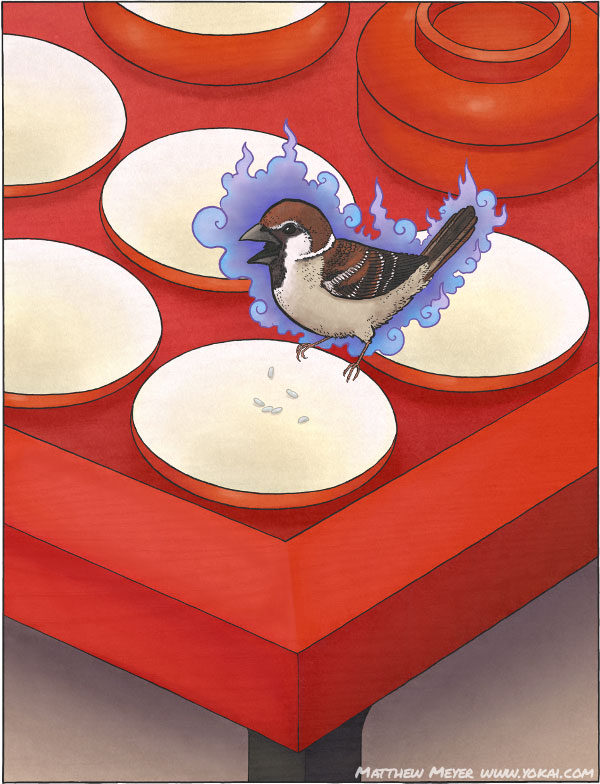
Sansei (山精, さんせい)

Sansei literally means “mountain sprite,” unspritely as this yokai is. It originally comes from China, where it is known as sanki, or “mountain demon” — though it is not quite demonic either, having no horns.

Sansei has a single foot (like some other mountain spirits we have looked at), but his foot is turned backwards. He lives deep in the mountains and occasionally pays visits to woodcutters’ cottages and steals their salt. Why? To put on crabs, of course! Sansei’s favorite food is stone crab, which he likes to broil and sprinkle with salt to eat. Sansei is sometimes referred to as the leader of all of the animals of the mountains.

Though not very aggressive, they do sometimes attack humans. When this happens, if one calls out, “Hiderigami!” the sansei will flee in terror. However, if one calls out, “Sansei!” instead, that person will meet some horrible fate, such as falling ill or having their house catch on fire.

Nothing else is written about this yokai… but if you notice that your salt has gone missing, check your trash bin for crab shells!

Sansei